
In our previous post, we explored the alarming environmental price tag of “Big AI” – a trajectory defined by massive data centers, skyrocketing water consumption, and energy demands rivaling entire nations. But if Big AI is the gas-guzzling SUV of the digital age, do we have an alternative? In this post, we will discover what Sustainable AI would look like.
A quiet revolution is building in the open-source community: the rise of Small Language Models (SLMs) and task-specific AI. These technologies offer a path away from the brute-force approach of Silicon Valley giants and toward a future that is accessible, efficient, and sustainable.
The Quiet Revolution: Small is Mighty
We have been sold a narrative that for an AI model to be “smart,” it must be massive. Small LMs are flipping the script on this mantra.
These models are orders of magnitude smaller than traditional Large Language Models (LLMs). While top-tier models from OpenAI or Google rely on hundreds of billions of parameters, the smallest efficient models can be 5,000 times smaller.
They use less data, significantly less compute, and a fraction of the energy, yet for many day-to-day tasks, they maintain a comparable level of performance. The benefits extend far beyond just saving electricity:
- Radical Accessibility: Because they are so lightweight, SLMs can run locally on your laptop, your phone, or even inside a web browser. This democratizes AI, allowing developers to build state-of-the-art applications without renting time on a massive, carbon-intensive cloud server.
- Quality and Trust: “Big AI” scrapes the entire internet, including the garbage. In contrast, training datasets for many SLMs (like those from Hugging Face) are often carefully curated and explicitly chosen for quality. This makes smaller models less likely to hallucinate, spew toxicity, or spread misinformation.
- Data Sovereignty: Because they are cheaper to train and deploy, startups and local communities can afford to build their own. This breaks the monopoly of Big Tech, allowing for AI that respects local data privacy and cultural nuance rather than imposing a “one-size-fits-all” model from California.
Beyond Chatbots: Task-Specific AI is Sustaianble AI
To achieve true sustainability, we must also look beyond the “Chatbot” paradigm. An LLM might be able to write a college essay about climate change, but it cannot predict a flash flood or optimize a solar grid.
For real-world impact, we need Task-Specific AI. These are models designed to do one thing exceptionally well, with minimal energy waste.
- The Galileo Models: Developed by a NASA-funded team, these models handle critical earth-science tasks like crop mapping and flood detection. They don’t require supercomputers, making them accessible to nonprofits and developing governments that need them most.
- Bioacoustic Monitoring: The non-profit Rainforest Connection uses AI models so efficient they run on upcycled old cell phones powered by solar panels. These devices listen to the rainforest to identify endangered species and detect the sounds of illegal logging chainsaws in real-time.
- Decarbonizing the Grid: Open Climate Fix utilizes AI to analyze satellite imagery and topography to predict the output of wind and solar installations with high precision. This helps energy grids balance loads and move away from fossil fuel reliance.
The Missing Piece: Transparency and Accountability
If we want to choose sustainable AI, we need to know what we are “buying.” Currently, when you type a prompt into a chatbot, you have no idea if that query emitted 1 gram of CO2 or 100 grams.
We cannot make sustainability-minded decisions about AI if we remain in the dark.
This is where initiatives like the AI Energy Score come in. This project tested over 100 open-source models, assigning them efficiency scores from 1 to 5 stars. The findings were stark:
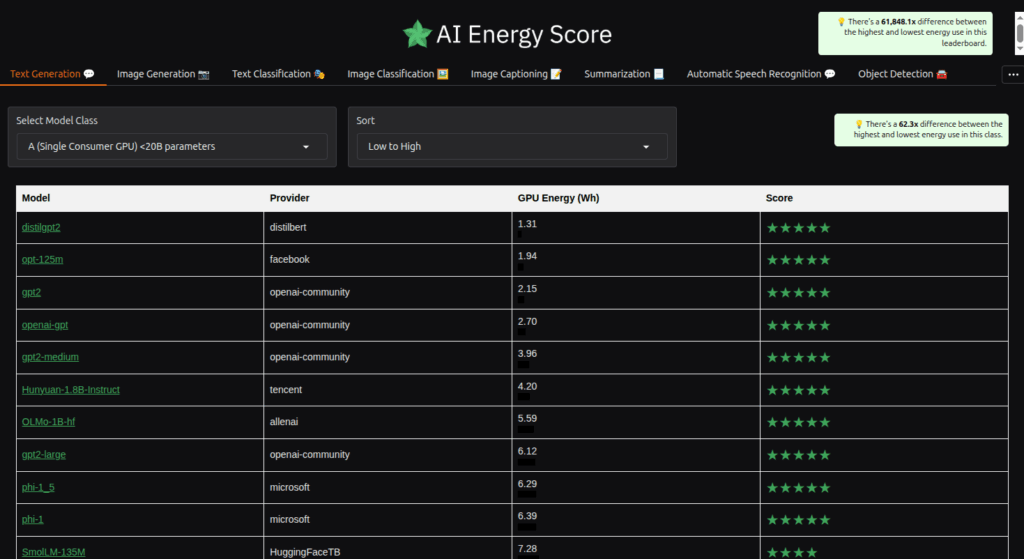
Asking a simple question like “What is the capital of Canada?” consumed 150 times more energy using a massive model (like DeepSeek) compared to a highly efficient Small Language Model (like SmolLM).
We must demand accountability. While the EU AI Act is taking steps toward voluntary disclosures regarding resource use, we need global standards. We need to hold Big AI accountable for their footprint.
Sustainable AI: Taking Back the Wheel
We do not have to accept the future sold to us by the tech giants—a future built on monolithic models powered by infinite energy consumption.
With every query we run and every model we choose to deploy, we have a vote. We can shape an alternative future where AI is decentralized, transparent, and environmentally conscious. A future where our technology serves all of humanity, not just the quarterly earnings of a few corporations.